

How To Install Maven Dependencies In Eclipse
This tutorial describes the usage of Maven within the Eclipse IDE for building Coffee applications.
1. Using Maven with the Eclipse IDE
The Eclipse IDE provides back up for the Maven build. This support is developed in the M2Eclipse project.
It provides an editor for modifying the pom file and downloads dependencies if required. Information technology also manages the classpath of the projects in the IDE. You lot can besides utilize wizards to import existing Maven projects and to create new Maven projects.
2. Installation and configuration of Maven for Eclipse
ii.1. Installation of the Maven tooling for the Eclipse IDE
Most Eclipse IDE downloads already include back up for the Maven build system. To bank check, apply and bank check if you tin see the Maven logo (with the M2E) sign.

If Maven support is not yet installed, the following description can be used to install it.
Installation of Maven support into the Eclipse IDE
To install Maven support, select the menu entry. To use the latest release, enter the following URL in the Works with field.
http://download.eclipse.org/releases/latest For the usage of Maven for Coffee projects, you only demand the m2e component.
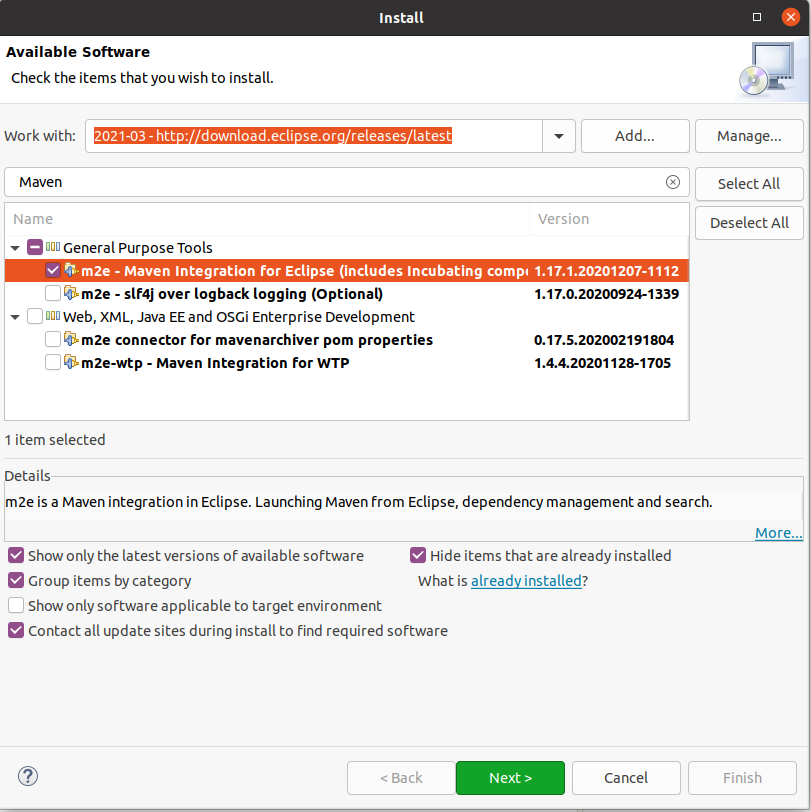
2.2. Configure automatically updates of Maven dependencies
In nigh cases information technology is useful if changes in the Maven configuration automatically updates the project settings.
Therefore, et the Automatically update Maven projects configuration flag under .
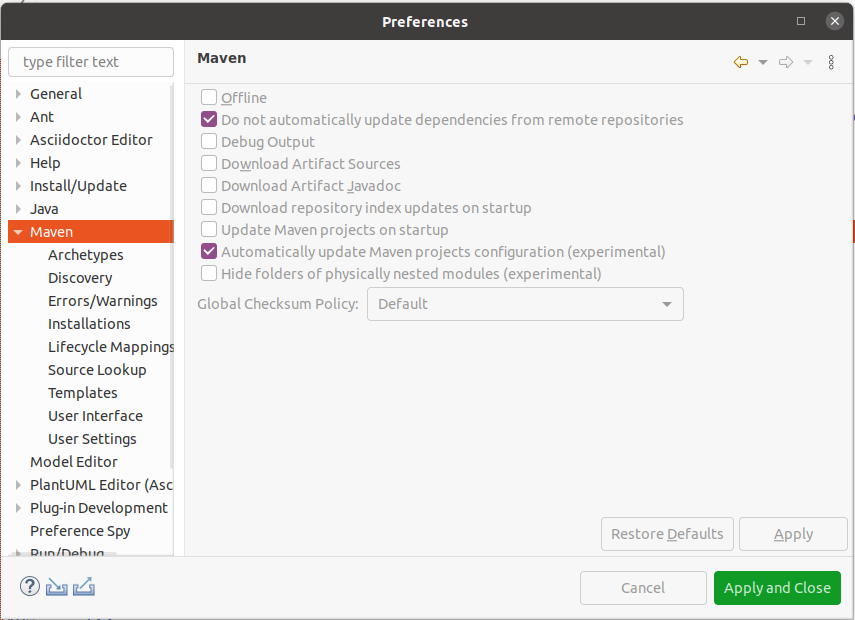
3. Exercise: Create a new Maven project via the Eclipse IDE
In this exercise y'all learn how to create a new Maven projection with the Eclips IDE.
3.1. Create Maven project
Create a new Maven project via .
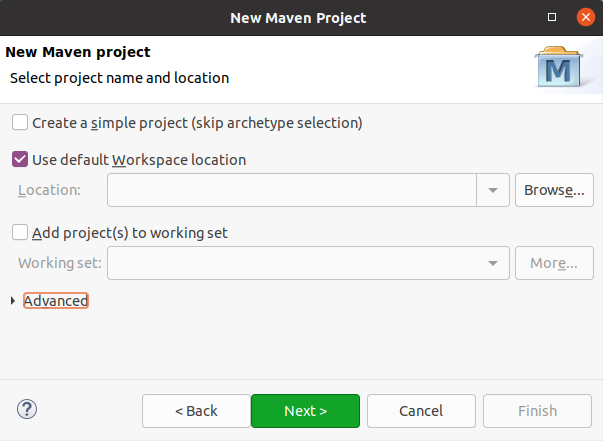
On the first magician page, you can select if you want to create a unproblematic project. In this instance you lot skip the archetype option. In this practice we want to apply an classic as template for our projection creation.
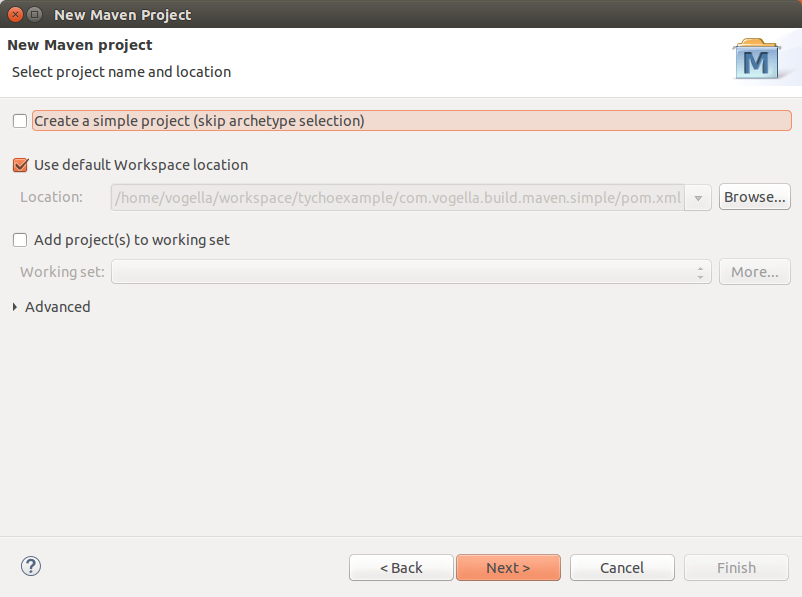
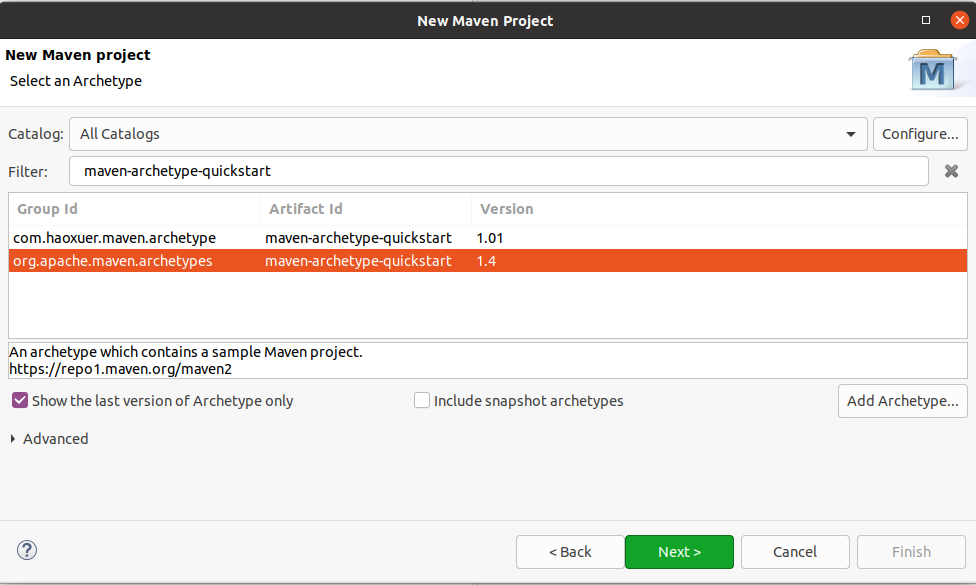
Press next, filter for the "maven-classic-quickstart" archetype and select the entry with the apache group. This is the classical Maven instance archetype for project creation.
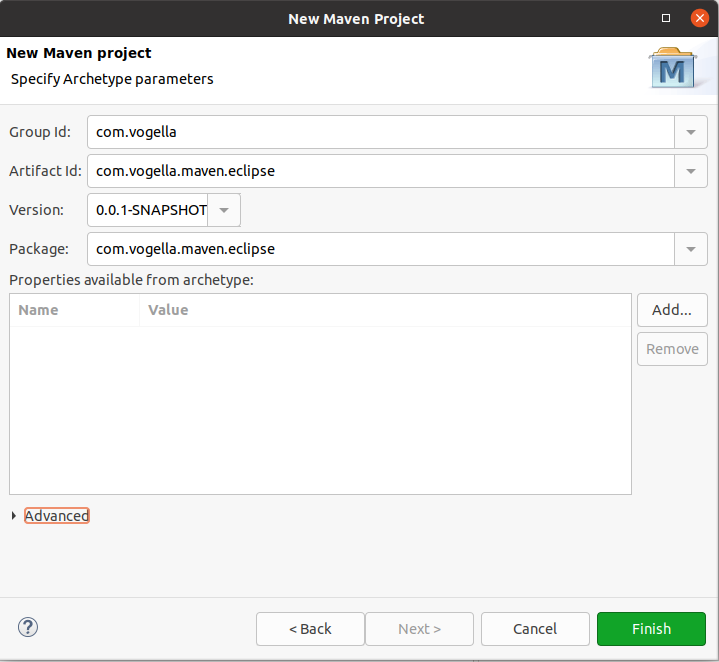
On the terminal tab enter the GAV of your project similar to the post-obit screenshot.
three.2. Update project to use Java
Change the pom file of the generated projection to use Java 11. For this re-create the following code onto the content via the pom.xml tab of the Maven editor.
<?xml version="1.0" encoding="UTF-8"?> <project xmlns= "http://maven.apache.org/POM/four.0.0" xmlns:xsi= "http://world wide web.w3.org/2001/XMLSchema-case" xsi:schemaLocation= "http://maven.apache.org/POM/4.0.0 http://maven.apache.org/xsd/maven-four.0.0.xsd" > <modelVersion>iv.0.0</modelVersion> <groupId>com.vogella</groupId> <artifactId>com.vogella.maven.eclipse</artifactId> <version>0.0.1-SNAPSHOT</version> <name>com.vogella.maven.eclipse</name> <url>http://www.vogella.com</url> <properties> <projection.build.sourceEncoding>UTF-eight</project.build.sourceEncoding> <maven.compiler.source>11</maven.compiler.source> <maven.compiler.target>eleven</maven.compiler.target> </backdrop> </project> three.3. Update Maven settings in Eclipse
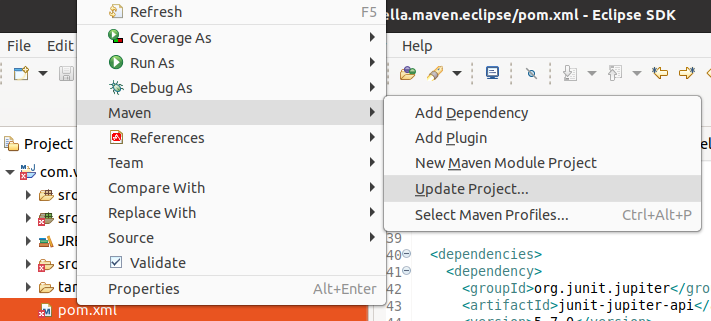
Right-click your project and select and update your projection.
3.4. Validate
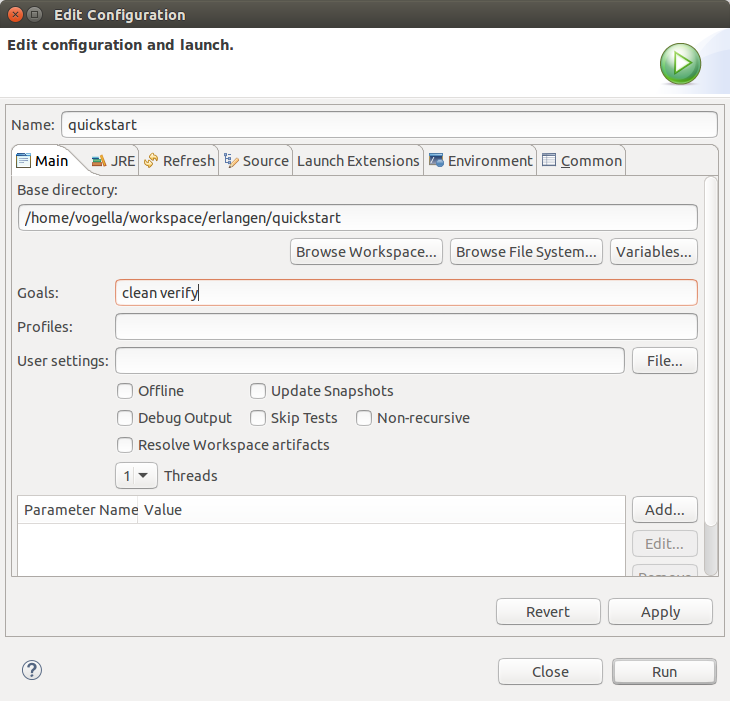
Validate that the Maven build is correctly configured past running the build. For this right-click the pom.xml file and select .
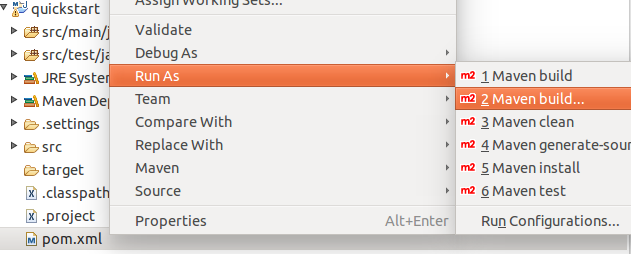
This opens a dialog which allows to define the parameters for the offset. Enter clean verify in the Goals: field and press the Run button.
4. Exercise: Adjust generated projection to use JUnit5 and external libraries
In this exercise yous accommodate your generated project to employ JUnit5.
4.1. Modify generated project
Change the pom file of the generated projection to use JUnit 5. For this re-create the post-obit code onto the content via the pom.xml tab of the Maven editor.
<?xml version="1.0" encoding="UTF-8"?> <project xmlns= "http://maven.apache.org/POM/4.0.0" xmlns:xsi= "http://world wide web.w3.org/2001/XMLSchema-instance" xsi:schemaLocation= "http://maven.apache.org/POM/4.0.0 http://maven.apache.org/xsd/maven-4.0.0.xsd" > <modelVersion>iv.0.0</modelVersion> <groupId>com.vogella</groupId> <artifactId>com.vogella.maven.eclipse</artifactId> <version>0.0.1-SNAPSHOT</version> <name>com.vogella.maven.eclipse</name> <url>http://www.vogella.com</url> <properties> <project.build.sourceEncoding>UTF-viii</project.build.sourceEncoding> <maven.compiler.source>11</maven.compiler.source> <maven.compiler.target>eleven</maven.compiler.target> </properties> (i) <build> <plugins> <plugin> <artifactId>maven-surefire-plugin</artifactId> <version>ii.22.2</version> </plugin> <plugin> <artifactId>maven-failsafe-plugin</artifactId> <version>two.22.2</version> </plugin> </plugins> </build> (2) <dependencies> <dependency> <groupId>org.junit.jupiter</groupId> <artifactId>junit-jupiter-api</artifactId> <version>v.seven.two</version> <scope>examination</telescopic> </dependency> <dependency> <groupId>org.junit.jupiter</groupId> <artifactId>junit-jupiter-engine</artifactId> <version>five.7.2</version> <scope>test</scope> </dependency> </dependencies> </projection> 4.2. Update Maven
Correct-click your project and select and update your projection.
4.three. Update test
Update your generated test to JUnit 5 via the following:
parcel com.vogella.maven.eclipse ; import static org . junit . jupiter . api . Assertions . assertTrue ; import org.junit.jupiter.api.Examination ; public class AppTest { @Test public void shouldAnswerWithTrue () { assertTrue ( true ); } } four.iv. Adding dependencies to your project
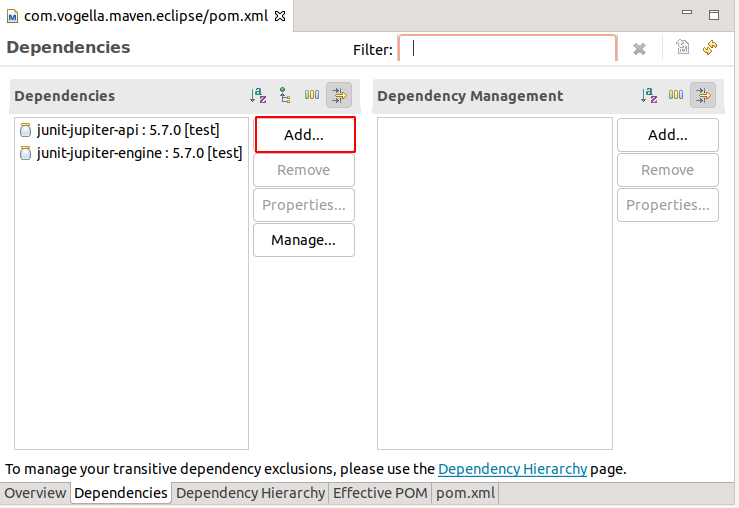
The Eclipse Maven tooling makes adding dependencies to the classpath of your project simple. In can directly add it to your pom file, or use the Dependencies tab of the pom editor.
Switch to the Dependencies tab and press the Add together button.
| If the Maven index was downloaded yous can also search directly this dependency via the dialog. |
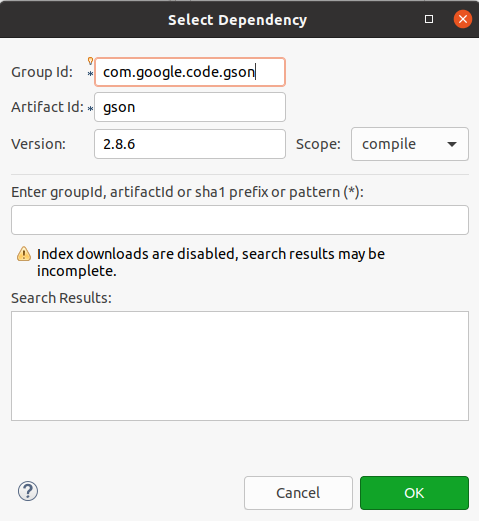
Right-click your project and select and update your project.
4.five. Use library
Change or create the App.java grade in your src/main/coffee binder. This classes uses Gson. Equally Maven added it to your classpath, information technology should compile and you should be able to kickoff the grade via Eclipse.
package com.vogella.maven.lars ; import com.google.gson.Gson ; public class App { public static void chief ( String [] args ) { Gson gson = new Gson (); System . out . println ( gson . toJson ( "Hello World!" ) ); } } 4.half dozen. Validate
Run the Maven build again and verify that the build runs successfully.
five. Do: Converting a Coffee project (create with Eclipse) to Maven
This exercise demonstrates how to catechumen a Coffee project to a Maven project.
5.1. Create Java project
Create a new Java project chosen com.vogella.build.maven.unproblematic in Eclipse.
Add together i grade called Principal. This class should have a main method, which write "Hello Maven!" to the command line.
package com.vogella.build.maven.simple ; public class Chief { public static void main ( String [] args ) { System . out . println ( "Hullo Maven!" ); } } 5.2. Convert to Maven project
Select your project, right-click on information technology and select .
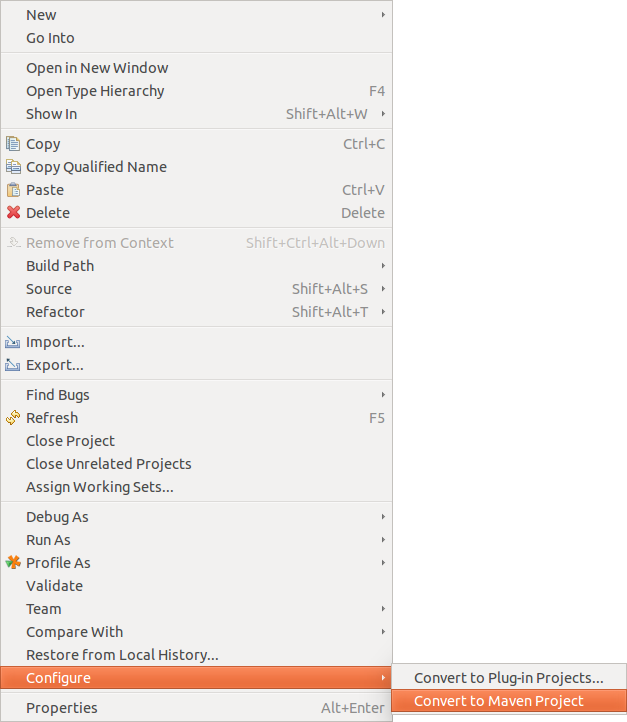
This creates a pom.xml file similar to the following.
<project xmlns= "http://maven.apache.org/POM/four.0.0" xmlns:xsi= "http://www.w3.org/2001/XMLSchema-case" xsi:schemaLocation= "http://maven.apache.org/POM/iv.0.0 http://maven.apache.org/xsd/maven-4.0.0.xsd" > <modelVersion>four.0.0</modelVersion> <groupId>com.vogella.build.maven.simple</groupId> <artifactId>com.vogella.build.maven.elementary</artifactId> <version>0.0.1-SNAPSHOT</version> <build> <sourceDirectory>src</sourceDirectory> <plugins> <plugin> <artifactId>maven-compiler-plugin</artifactId> <version>iii.one</version> <configuration> <source>one.8</source> <target>1.8</target> </configuration> </plugin> </plugins> </build> </projection> five.3. Execute the Maven build
Right-click the pom.xml file and select .
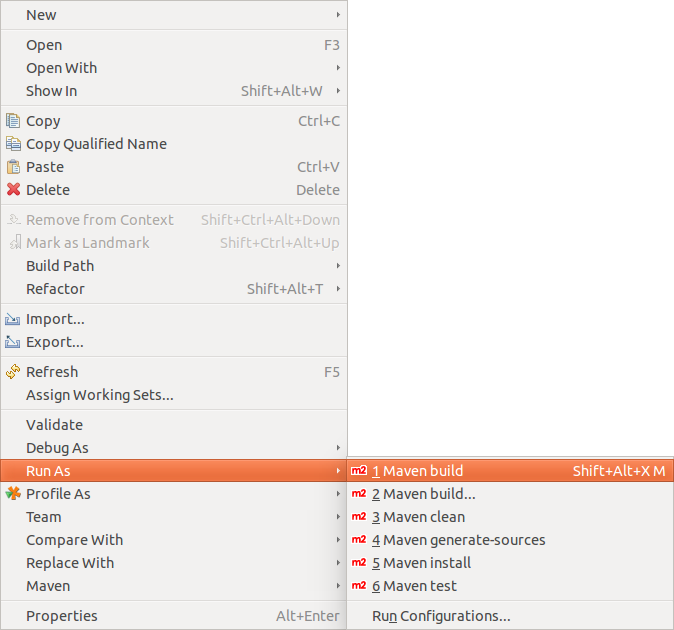
Enter "clean install" as Goal.
| You lot accept to enter the goals manually. The Select… button does non piece of work, the dialog it displays is ever empty. |
Printing the Finish button. This starts the build, which y'all can follow in the Console view.
Once the build finishes, press F5 on the project to refresh it. You see a target folder, which contains the build artifacts, e.yard., a JAR file.
vi. Exercise: Create a Java web project in Eclipse using Maven
This exercise demonstrates how to create a web application in Eclipse which uses Maven. It assumes that you have already configured Eclipse for the creation of spider web applications.
6.1. Create Maven web project project
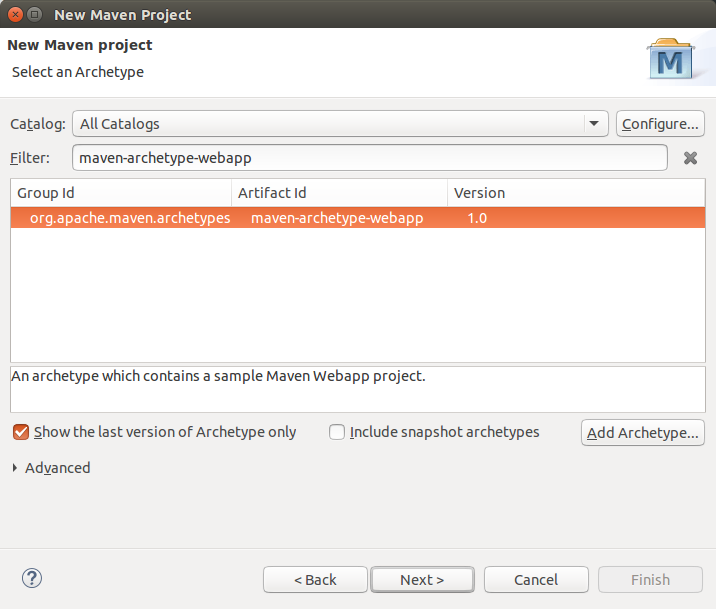
Create a new Maven project called com.vogella.javaweb.maven.start via the entry. On the classic selection, select the maven-archetype-webapp entry and click the Next button.
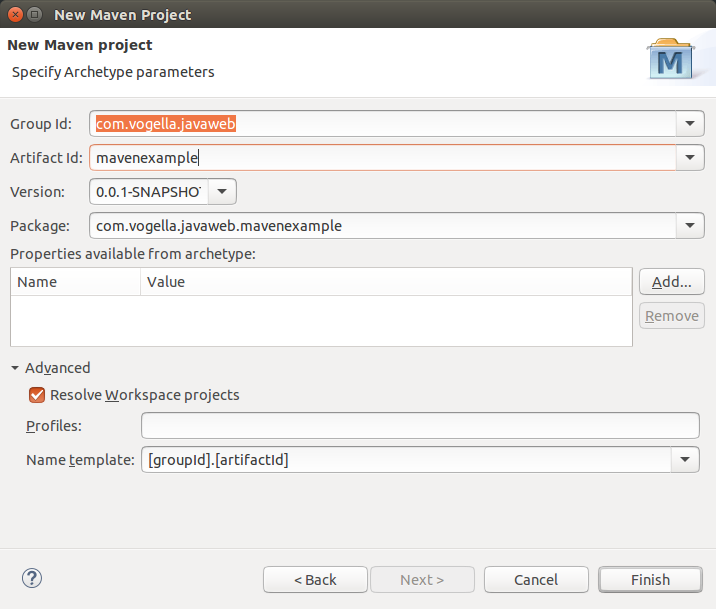
Enter the group, artifact and version of your new Maven component.
| You may see the error: The superclass "javax.servlet.http.HttpServlet" was not found on the Coffee Build Path. To fix this, correct click on your project and select Properties. On the Targeted Runtimes select your spider web server entry, e.grand., Tomcat. |
6.two. Build your projection
Run your mvn clean verify build command from Eclipse. Validate that there are no issues with the build.
6.3. Run on the server
Correct-click your project and select the menu entry.
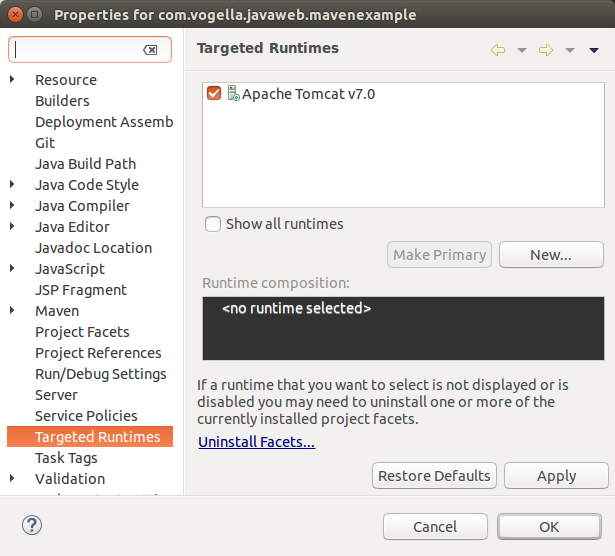
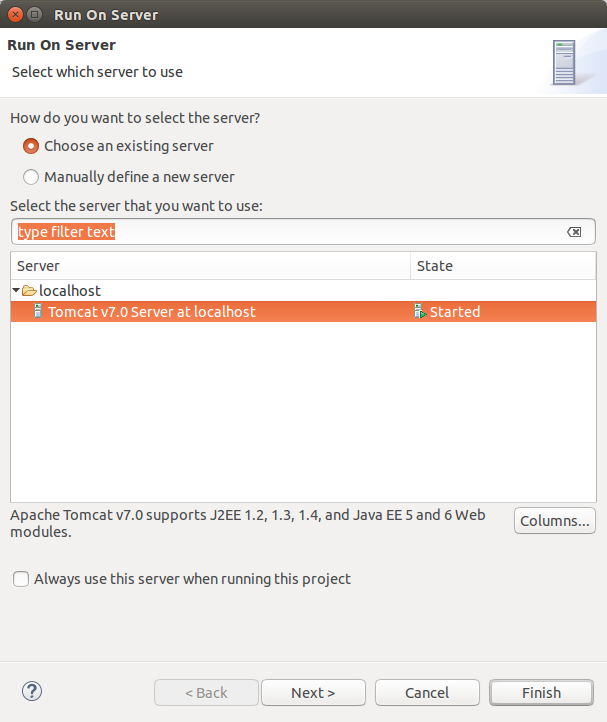
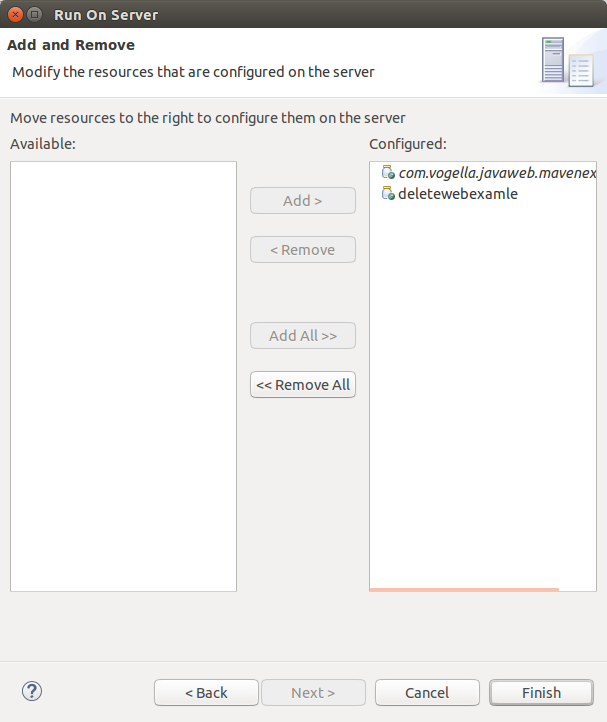
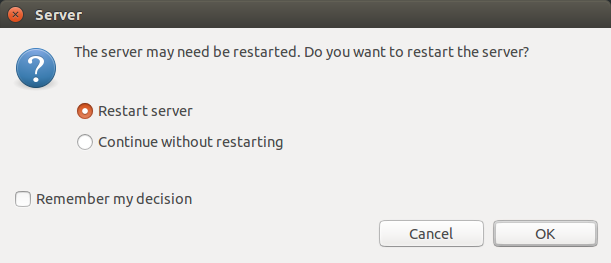
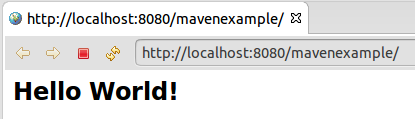
If you open a browser you should be able to access your webapplication.
seven. Exercise: Debug tests
Add a breakpoint in Eclipse in one of your tests.
Start your Maven build on the commadline with the debug parameter.
mvn -Dmaven.surefire.debug test This stop the command line build one time the tests are executed and listen on port 5005 for a remote connection.
In Eclipse select the and create a new Remote Java Application run configuration.
prototype::maven-exam-debug10.png
Ensure to enter the correct project and the port 5005. Press the btn:Debug[] to connect to the running build. Yous tin now debug your exam.
viii. References for Webdevelopment with Eclipse
To use Maven in Eclipse for Java web development, y'all should also install an configure the Eclipse spider web development tools (WTP). See Eclipse Web Evolution Tools for a tutorial.

Source: https://www.vogella.com/tutorials/EclipseMaven/article.html
Posted by: sevignymues1965.blogspot.com
0 Response to "How To Install Maven Dependencies In Eclipse"
Post a Comment