

How To Replace Or Repair A Loose Well Cap
 Well Caps, Covers & Vents
Requirements for caps, covers & vents on wells
- Postal service a QUESTION or COMMENT nigh steel casing drilled h2o wells at residential backdrop
InspectAPedia tolerates no conflicts of interest. We have no human relationship with advertisers, products, or services discussed at this website.
Well Cover & Cap Requirements & Well Cap Venting:
Water wells require a water-tight cap or cover to prevent contamination from surface runoff or flood waters. But some well caps also require an air vent. This article explains the requirements for well caps & covers & well cap or comprehend venting for drilled wells, well casings, dug wells & well pits.
This article series describes the properties & structure of drilled wells that use a steel well casing, modernistic drinking water wells. We discuss well problem diagnosis, testing, & repair procedures - communication about what to practice when things go wrong with the well such equally loss of water force per unit area, not enough water book, contaminated wells, wells that take smelly h2o, wells that just run out of water or have a low recovery charge per unit. Nosotros describe the parts of a water well and its piping and controls including the pitless adapter.
We also provide an ARTICLE INDEX for this topic, or you lot can endeavor the page summit or lesser SEARCH BOX as a quick style to detect information you lot need.
Well Caps, Covers, & Vents
 Hither we describe requirements & recommendations for a sanitary, sealed cap or encompass on drilled wells, bored wells, and cover requirements for dug wells and well pits.
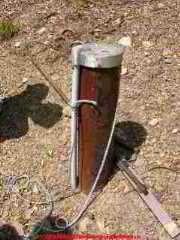
The folio top photograph is of a mod well casing, in skilful status, extended properly higher up footing. The small-diameter piping parallel to the six-inch steel well casing is an electrical conduit - so we know that for this particular h2o supply system a submersible water pump is used and it is installed in the well itself.
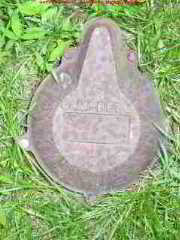
The photo shown here is of an older drilled-well casing which has been placed with its casing cap at ground level - increasing the hazard of well contagion from surface runoff. We besides run into that this well cap is non vented.
We cannot see from merely the photo how successfully this well casing embrace has been sealed confronting water entry from surface runoff.
[Click to enlarge any image]
Well casing covers on older drilled or bored wells that used a steel casing are oftentimes buried several feet below ground. Those well casing caps must also be tightly sealed against water entry from surface runoff or groundwater.
Where the pump is commencement from the well or where a submersible pump is used, the opening between the well casing and any pipes or cables which enter the well shall be closed by a watertight seal or "well cap". - California DWR Affiliate 10, 2022 cited below
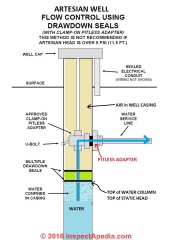
In our sketch below we show the typical construction of a drilled water well in cross department.
A typical drilled well steel casing bore is six" (4" in some areas), that the well depth tin can be considerable (from 50 ft. to 900 ft. or more). Typically the steel well casing extends downwardly into the bedrock or to a depth at which information technology tin be sealed confronting united nations-wanted surface water entry.
Nosotros talk over the construction of drilled wells
at DRILLED WELLS, STEEL CASINGS.
The water piping leaving this well to conduct water to the building will be buried below ground, and in freezing climates, beneath the frost line. A special fitting, the "pitless adapter" is used to seal the passage cut into the circular well casing. Details are at PITLESS ADAPTER
Question: What is the function of a well vent?
 2016/06/ten Julian said:
What is the function of a well vent?
This question was posted originally
at H2o ODORS, CAUSE CURE
Respond:
Good question Julian; Here are some reasons that many drilled wells with a sealed casing pinnacle or sealed cover require a vent:
- Well cap/casing vent prevents casing vacuum: On some water wells the presence of a water tight (and thus air tight ) well casing cap can mean that when the pump is running and drawing down the static head in the well it tin create a vacuum that could impede pump operation; The vent lets equalizing air into the casing.
- Well cap/casing vent allows air to vent out: The well casing top vent also allows air to exit the well as the water cavalcade rises in the well, perhaps assisting in well recovery in some well installations.
- Well cap/casing vent allows gases to vent out: A well vent also allows the venting out of any gases that might accumulate in the well bore above the static head; that tin can be a concern for wells whose water supply includes absorbed methane or other gases.
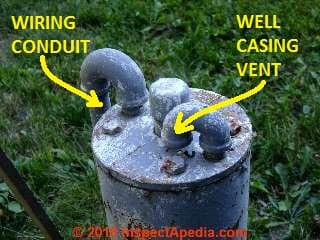
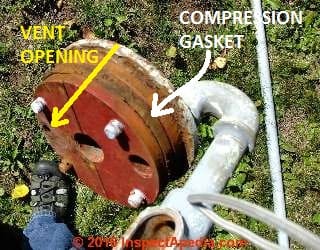
Below: a closer look at the older compression-mode well casing cap removed from the well shown higher up.
This cap achieved a water tight seal to the interior of the well casing when the cap bolts were tightened to in turn squeeze and expand the thick prophylactic gasket.
A small diameter hole in the well casing cap (yellow arrow) connected to an air vent elbow on the pinnacle of the casing encompass (visible in the photo above).
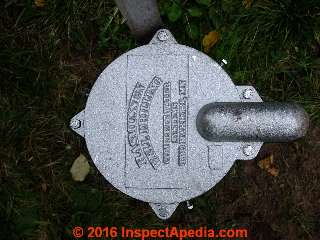
Beneath: new well cap sealed to the well casing; note that the well driller determined that this well no longer needed an air vent, probably because in the well a snifter valvewas eliminated every bit function of installation of a new internal-float type force per unit area tank in the building served by this well in Two Harbors MN, USA.
See details at
Water TANK BLADDERS & Convict AIR
and at
SNIFTER & Bleed BACK VALVES
Requirements & Standards for Well Casing Cap Vents
Here's an excerpt from the California DWR well standard
Air Vents. In customs water supply wells to minimize the possibility of contamination caused by the creation of a partial vacuum during pumping, a casing vent shall be installed (Figure 7). In addition, to release air trapped in the pump column when the pump is not running, air release vents shall be installed (Figure seven).
Air vents are also recommended for other types of wells except those having jet pump installations requiring positive force per unit area (which cannot have a vent). - California DWR Chapter 10, 2022 cited below, [Emphasis by underscoring added by editor - InspectApedia.com]
Here is another extract from California's Chapter ten on well construction codes:
Openings. Openings into the top of the well which are designed to provide access to the well, i.e., for measuring, chlorinating, adding gravel, etc., shall exist protected confronting entrance of surface waters or foreign matter by installation of watertight caps or plugs. Access openings designed to permit the entrance or egress of air or gas (air or casing vents) shall stop to a higher place the footing and in a higher place known flood levels and shall be protected against the entrance of strange fabric by installation of downward-turned and screened "U" bends (see Figures half-dozen and 7). All other openings (holes, crevices, cracks, etc.) shall be sealed. - op. cit.
You lot'll see that the vent must exist properly synthetic so every bit to forestall entry of surface runoff, flood waters or other contaminants into the well bore.
- "Water Well Standards", [PDF] California Department of Water Resources, 1416 9th Street, Sacramento CA 95814, TEl: 916-653-5791, DWR Affiliate 10, retrieved 2022/06/10, original source: http://www.water.ca.gov/groundwater/well_info_and_other/california_well_standards/wws/wws_combined_sec10.html
Safety Requirements for Well Caps & Covers
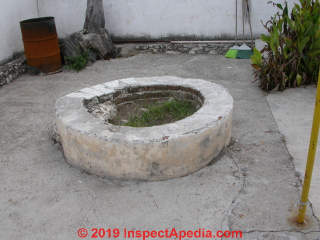 We accept explained above that the top of a water well needs to be sealed against surface runoff or inundation waters as those waters are not sanitary and would contaminate the well water. Well structure also requires that all below-ground well openings such at a pitless adapter must besides be sealed against the entry of outside water.
Only well caps and covers must also be secured to forestall other safety hazards such as the following:
- The well cap must be secured against casual removal that would permit tossing of debris, disposal of varoius chemicals or liquids, or dropping of objects into the well as adventitious, criminal, mischevious acts. In virtually situations that simply means that the cap can't exist lifted off past hand but has fasteners that must be removed: that's enough to forbid a child from opening the well.
- Community wells require additional protection:
Enclosure of Well and Appurtenances. In customs water supply wells, the well and pump shall be located in a locked enclosure to exclude admission by unauthorized persons. -California DWR Chapter 10 op. cit.
- Dug wells should have a child-proof comprehend to prevent a child from climbing into or falling into the well.
See DUG WELLS, by Mitt
and
Run into WELL SAFETY WALL & COVER - Well pits should have a child-proof cover also to preclude a child from falling or climbing into the well pit. Because the embrace of a well pit is often at or close to ground level, the cover should as well be potent enough to foreclose collapse and injury to someone walking over or standing on information technology.
Also see WELL PITS
Reader Comments & Q&A
 @Darlene,
My goodness that does audio farthermost.
In New York licensed plumbers and also drilled well construction companies are completely capable of tightening a loose well casing cap - in fact if all that's needed is tightening a few screws or bolts that snug the cap to the casing peak, anyone with a screwdriver or an adjustable wrench could practise information technology.
But on the other manus if the well casing is non well above ground and if the cap was constitute off entirely and / or if the proper kind of cap was not installed in the outset place, so the well may non be protected from surface contaminants; in that example it may exist that a proper cap needs to be installed.
Call your local well driller, ask them to inspect the casing top and either secure the cap or tell you if a different one is needed.
In NYS any well driller in business has got to exist NYS DEC registered.
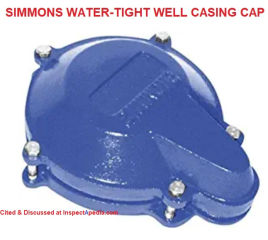
The Simmons water-tight well casing cap shown below costs about $60. U.S. to which you'll add together the cost of a well driller service call.
Belongings Transfer Tests for vacant home. The New York Erie Canton Wellness denial reads Well h2o failed due to loose cap. It states that I need to rent a New York Land Section of Environmental Conservation Registered Well Driller to put a new cap on and and so they volition proceed to do h2o test.
Is this a legal requirement to have this kind Specialized Registered person to replace a cap?
The wellness department inspector will not answer me equally to why they did not do the water test. He said the Health department will non talk to me since I am now not the possessor—only I explained to him I paid for the test, my money is held in escrow to pay for septic/well repairs and my sellers contract states I am the one to hire repair person, non the new owner. My lawyer is not helpful. I don't know the police.
@inspectapedia.com.moderator, Thanks for the groovy tips!
@James M,
RE:
1. Run conduit down and connect to conduit running from the house to protect the wires.
if you use underground feeder at adequate depth you don't demand conduit beneath ground only I'd not look to see wires exposed like in your example - conductors with no insulation and I prefer to see conduit above ground to protect the wire from impairment
2. Add some form of insulation. Perhaps like a thermal blanket for hot h2o heater?
There is no reason to insulate the casing above ground; the water should be leaving the casing beneath ground, below the frost line, by a pitless adapter
3. Replace cap with proper plumbing equipment one
Yes one that fits and connects both casing and conduit
four. Do I fill in or build something to go out a "work space" around the well?
The casing can be left exposed above basis if wired and capped properly; Don't bury it or it may leak and contaminate your well; it should extend above ground.
@inspectapedia.com.moderator, yes it's sketchy. The conduit is there when it runs to the business firm. So your recommendation is:
1. Run conduit down and connect to conduit running from the house to protect the wires.
2. Add some form of insulation. Maybe similar a thermal blanket for hot h2o heater?
iii. Replace cap with proper plumbing fixtures 1
4. Exercise I make full in or build something to leave a "work space" effectually the well?
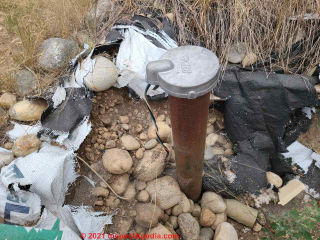 @James M,
This looks like an improper and unsafe submersible well pump installation.
I see bare wires, no conduit and not even protective insulation run loose through a rocky ground surface, up into a well casing cap that, if it sits loosely atop the casing, is mayhap the wrong size - likewise large - thus also not secure against movement, wiring impairment, and not able to prevent its removal or contaminants from being dumped downwardly the casing at its acme.
You lot volition want at to the lowest degree
- a h2o-tight well casing summit of the correct size for your well casing so that it tin be secured and sealed
- proper conduit to protect the pump's electrical wires
- a water test to confirm that the water is potable and condom
I recently purchased a dwelling house with a drilled well. The pump is inside the well itself.
The cap simply sort of sits on top. At that place was a pit dug around it with rotten wood laid flat at footing level, surrounding the well pipage. There was styrofoam packaging used equally insulation...
My question is, what is the best way to comprehend this dorsum upwardly? The pigsty goes deep enough to run into where the power and piping shoot off to the house. Do I demand to build something effectually this for access if there'due south a problem, or just fill it with dirt and gravel?
@Kate smith, the start and well-nigh essential question is that of safety and be absolutely certain that no i including a curious child, can autumn into the well.
With that taken care of if you're going to remove the roof you may want to simply cover the wall to forestall surface water and dust and rain from inbound it.
I accept a well in my garden with a 3 human foot wall and sloping roof above it. There is a metallic grill set up within the wall to prevent falling into the well. I would like to remove the sloping rood equally I think its rather naff. Would this affect the well. We dont actually apply information technology.
Our well flooded from sump pump in well housing non working, force per unit area tank came loose over again, four packrats in the housing, water tastes similar a swamp and looks like little organisms in it. Could pressure tank, piping between well casing and pressure tank have adult leaks?
Cinda,
Thank you for asking a helpful question.
If y'all are going to bury an above footing well casing cap (this is Non recommended), and then information technology'due south of import to first assure that the top is completely sealed against water entry.
Otherwise leaks into the well may contaminate your water supply.
A plastic bag was a clever idea, but non reliable.
Likewise, some well casing caps include an air vent that should not be blocked.
I take a well, and a well head in my front end yard, I landscaped bricks around and put in a flower bed, I did encompass the well caput with plastic , will this give me a problem. Thank you
Aye, the well-cap might be buried - hopefully likewise sealed against water entry. That's particularly likely in an older home. Mod drilled wells are normally brought above grade; other older wells may have the well head exposed in a well pit that is unremarkably closed by a removable cover.
Take a wait at WELL LOCATION, HOW TO FIND https://inspectapedia.com/water/Well_Location.php
I just moved in to a residential home that has a drilled well. The as-congenital shows its location, but there is no visable well cap. Is there such a thing as a subsurface well cap?
10-4 thx
That might work provided your vent pipage is of sufficient diameter, slope, is routed with pitch and then that it doesn't clog and is protected and so that information technology doesn't get smashed past inadequate protection from vehicle passage.
Even so proceed in listen that it sounds as if you lot're driving correct over the well casing top- the well casing top needs both protection from damage AND ease of future access for maintenance or repair. Don't merely pave over it.
My vented sebmersible well pump well ended up where I need to drive over it. I would like to lower the sealed/vented lid, embrace/seal and run a vent to a more convenient above grade location vented and screened. That OK ??? .
my brother has a iii' diameter dug well that has a concrete acme/lid. He's at an age where he tin no longer remove the top to chlorinate the well. Is there an approved acme/lid he can get to replace his physical elevation/lid
If I place a wooden wishing well over my well cap, does this create any problems for cpas vent?
I simply moved into a new house and the h2o was tested to be potable drinking water.
Still, when I run the h2o within the house, (shower, toilet, or kitchen sink) I tin can visibly come across water sprinkling from different areas from underneath the cap on the well casing outside.
I spoke to the person that drilled with well, and he was trying to tell me that this was normal because we have a lot of pressure in the well. My business concern is that there is a lot of water running out and I have quite the puddle around it which is a concern for the winter fourth dimension as it volition plow to ice and build up.
I have been turning my h2o pump off at the elect. box for several weeks at a time. (i was out of town) I had no problem with information technology coming dorsum on when I needed information technology to. final time, my son had to prime it, using a gallon of water. The adjacent time nonetheless, when I primed it, it would come up on, concur the prime for a minute. pressure level went to 38 and then quickly lose its prime. what could be causing this. would turning it off so much, and for extended times crusade it to quit priming? I
Pete, please utilize the search box above to detect and check out the diagnostics in this article WELL Water PRESSURE DIAGNOSIS. http://inspectapedia.com/water/Private_Well_Pressure_Diagnosis.php
Question:
deepwell pump force per unit area problem. Water output has degraded & now water barely makes it to footing level. Notation: I think well is aprox 5yrs old w no pressure tank, only notwithstanding employ to pump the h2o from the well aprox 200yds & aprox and another+100' higher in peak to the 2000gal tank on the hill.
Water from tank (elev aprox 40' higher than house elev). And then the grunlove house pump (w pressure level external tank located at the business firm) would draw out & receive a little help in pressure from gravity.
Now I have to walk all the manner down to the well head plow on the deepwell pump just to fill up v gal buckets of from the spicket thats continued to the well head. any ideas to the problem?
Can I hook up a craftsman 390.2519 to help it? *The craftsman pump has 1 one/4 " suction line and 1" drive line, and a port for pressure level tank or injected air selection.
The shallow or deep pump caput option is sold seperately & I don't take either one.
Thanks Pete
Diane if your well casing included a top vent, and if the equipment hasn't been modified to make that vent unnecessary, I'd proceed the vent working; that might mean that you demand to extend information technology around your decorative rock. Likewise exist sure that yous don't change the ground tiptop so as to increase the risk of sending surface runoff into the well effectually the casing cap. On an older well that cap may not exist water-fight.
I but installed an artificial stone to cover my well pipe. My pipe looks exactly like the get-go photo on the page. Does this artificial rock demand to be vented?
...
Go on reading at WELL Construction & MAINTENANCE - home or select a topic from the closely-related articles beneath, or come across the complete Commodity Alphabetize.
Or see
DRILLED WELLS, STEEL CASINGS
PITLESS ADAPTERS - Definition & apply of a pitless adapter at h2o wells
WELL CASING LEAK REPAIRS
Suggested citation for this web page
WELL CAPS & COVERS at InspectApedia.com - online encyclopedia of building & ecology inspection, testing, diagnosis, repair, & problem prevention advice.
Or see this
INDEX to RELATED Manufactures: ARTICLE INDEX to Water SUPPLY, PUMPS TANKS WELLS
Or employ the SEARCH BOX found below to Ask a Question or Search InspectApedia
...
Ask a Question or Search InspectApedia
Questions & answers or comments about steel casing drilled water wells at residential properties.
Effort the search box just beneath, or if you prefer, post a question or comment in the Comments box below and we volition answer promptly.
Search the InspectApedia website
Note: appearance of your Comment below may be delayed: if your comment contains an image, spider web link, or text that looks to the software as if it might be a spider web link, your posting will appear after it has been canonical past a moderator. Apologies for the filibuster.
Technical Reviewers & References
Click to Show or Hide Citations & References
Publisher InspectApedia.com - Daniel Friedman

How To Replace Or Repair A Loose Well Cap,
Source: https://inspectapedia.com/water/Well_Casing_Cap.php
Posted by: sevignymues1965.blogspot.com
0 Response to "How To Replace Or Repair A Loose Well Cap"
Post a Comment